

Article details
When water leaks near an electrical appliance, avoid touching anything wet and cut power only from a dry breaker panel you can reach safely. Water that reaches an outlet, a plug or the base of the appliance is a reason to stop and book a diagnosis rather than run another cycle.
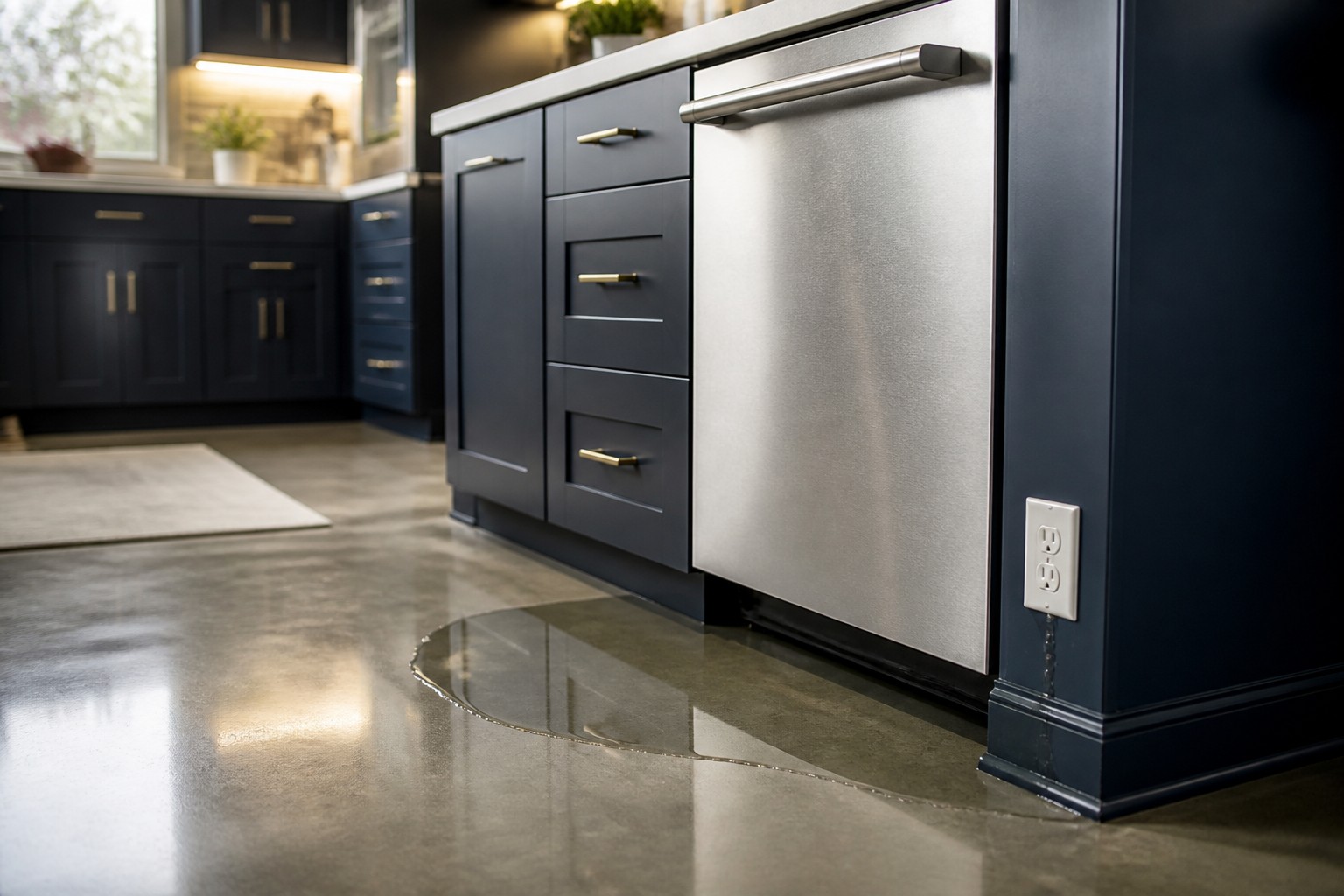
Finding water near an electrical appliance is unnerving, and it rarely happens at a convenient moment. The puddle by itself does not tell you which part has failed, so start with observations that are safe, repeatable, and useful should you schedule a Miele service visit later.
Upkeep belongs to the owner, while anything that calls for testing or dismantling does not. Interlocks and warnings exist for a reason, so do not work around a locked door, a tripped safety switch or an error message to stay in use. Write down what you see as you go; those notes make a later diagnosis quicker and more accurate.
Start with the simple conditions
Keep your hands off a wet appliance, plug or outlet. If you can reach a dry breaker panel safely, turn that circuit off before going near the spill. Inspect the appliance in its usual position and do not force panels, fittings or controls. Where a simple adjustment changes the result, run one normal cycle or operation before settling on a conclusion.
A hose that has simply worked loose in plain view may be an easy fix, but water reaching an outlet, a wiring area or the base of the appliance is another matter and calls for care. Watch for a pattern, such as every cycle, one particular load or setting, or only after a long run. Noticing that is worth more than restarting again and again.
The source decides how serious it is. A drip from a visible hose connection is a different problem from water that appears under a closed door or around the base, where the path to electrical parts is not visible.
| Circumstance | Recommended step | Do not |
|---|---|---|
| Water close to an outlet | Switch the circuit off at a dry breaker panel | Touch the plug |
| Drip from a hose you can see | Catch the water and keep watching | Run one more cycle |
| Source of the water unclear | Book a diagnosis | Open up an appliance that has power |
Safe checks that protect the appliance
Model-specific controls, filter access points and service intervals are all covered in the use-and-care manual. Limit cleaning to parts marked as user-serviceable, use only the cleaners the manual suggests, and seat every removable part back the way it was built to sit.
Prior to another cycle, remove whatever is in the way, lighten a load that is heavier than normal, and check that nothing restricts air movement, the incoming water or the space around the door. Repeated resets are best avoided because they may conceal an intermittent fault and leave water, heat or pressure in places they do not belong.
- Write down whatever message or error code is showing before you dismiss it.
- Inspect hoses, vents, seals and plugs by eye, leaving electrical connections where they are.
- Make one measured test run, not a string of repeated tries.
Fine for owners
- Cut power safely
- Catch the water
- Photograph the visible source
Leave to a technician
- Touching wet controls
- Running it while it leaks
- Opening electrical areas
Which leaks have a simple owner-level cause?
Some leaks have owner-level explanations in the manuals. On a dishwasher, spilled rinse aid can cause over-foaming in the next program, and one Miele manual says the rinse aid flap must be closed firmly so it clicks, otherwise water can enter the reservoir during a program. Door seals matter too: the same manual notes that the seal and door sides are not reached by the spray jets, so wipe them regularly.
For refrigerators with a water connection, the manual says the water shut-off valve must not be behind the appliance and should be placed where it can be reached, and that plumbing work belongs to a suitably qualified person.
Know when the symptom needs diagnosis
Should the symptom persist after the basic checks, stay on the owner side of the line. Anything involving gas connections, refrigerant lines, internal wiring or heating circuits, as well as pumps, motors and control boards, demands suitable test equipment and a technician who can confirm the repair is safe.
Arrange a visit without delay when a normal cycle cannot be completed, performance is getting worse, a breaker trips, you hear a fresh grinding noise, or something smells hot or burnt or leaks close to electrical parts. If the appliance displays a safety warning, stop operating it.
What does a dishwasher water protection system cover?
A Miele dishwasher may include a Waterproof system. The manual says it only works when correctly installed and maintained, and recommends closing the faucet before a long absence.
Some Miele dishwashers have a Waterproof system. According to one manual it works only if installed correctly and maintained, and the faucet should be closed during long absences. It works when the machine is switched off, provided it stays connected to power, which is one reason not to assume that cutting power removes every protection.
The same manual recommends checking the water inlet hose, power cord and drain hose for damage after installation and at regular intervals. Never keep using an appliance with a damaged power cord; the manual says it must be replaced through Miele Customer Service or a qualified technician.
After water has been near the electrical area, leave the appliance off until it has been inspected. Surface dryness does not tell you the inside is dry.
What to tell the technician
A technician will want the model number, a precise account of the symptom, the date it began, the settings that were chosen and the outcome of the safe checks above. A photo of a code or a verbal description of the noise is useful too, though removing a cover to get it is never worth it.
Looking carefully will not repair anything, but it is the strongest opening move. Sort out the simple conditions, hold on to useful error information, and leave anything electrical, gas-related, sealed-system or internally mechanical to a qualified Miele technician.
Common questions
Should I unplug a leaking appliance?
Only if the plug and the floor around it are completely dry. If water is near the outlet, turn off the circuit at a dry breaker panel instead and do not touch the plug.
Is a small puddle under a dishwasher an emergency?
The size is less important than the source. A leak near the base or electrical area is a reason to stop using it and arrange diagnosis, while a drip at an accessible connection can be contained and observed.
Can I run the appliance again once the floor is dry?
A dry floor does not show where the water came from. Wait for a diagnosis if the source is unknown or if water reached the base.
Need help now? Visit our services page or contact us.
Official manuals and support notes are available on Miele Support.
Before ordering anything, record the whole model number. A revised board or sensor can mean a different part number applies.
Powering the appliance down and up once can clear a temporary fault, yet a code that returns again and again generally points to a physical cause that is still present.
Vents and filters should stay unobstructed from one visit to the next, since poor airflow tends to imitate electrical and sensor problems.
Where there is water, a burnt smell or sparking, stop using the appliance and have a professional look it over.