

Article details
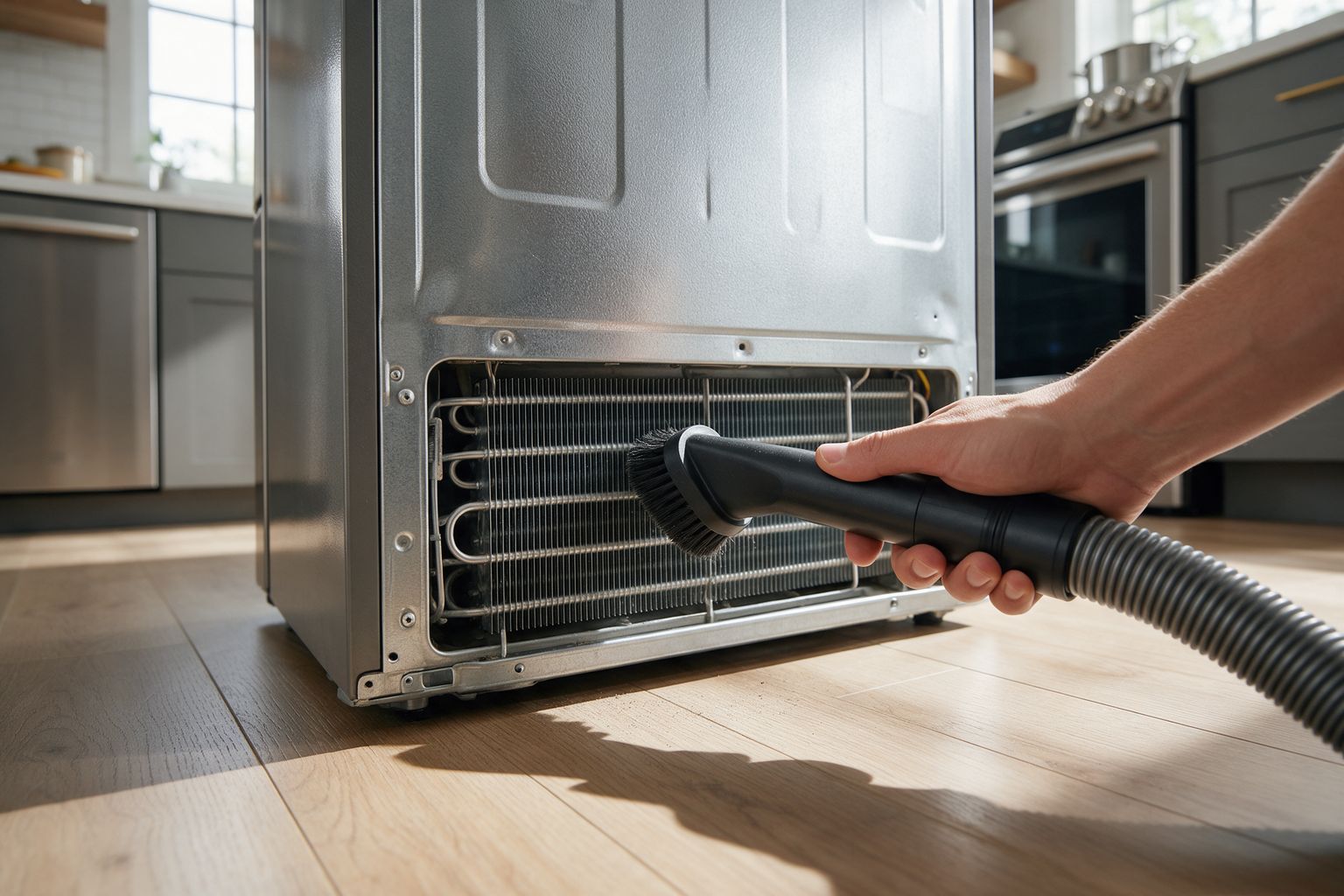
Refrigerator coil and seal care mostly means keeping the base ventilation slits free of dust, keeping the door seals clean and supple, and leaving air gaps around the cabinet. Covered or dusty slits are listed in the manual for one Miele refrigerator as a reason the compressor runs too often and too long. If a clean seal and clear slits do not change how often it runs, book a diagnosis rather than reaching behind panels.
Coil and seal upkeep rarely feels urgent until the refrigerator starts running more than usual. A single symptom cannot name a failed part, so begin with checks that are safe, can be repeated, and would give a Miele technician something concrete if you book a visit.
Upkeep you can do at home sits on one side; anything requiring testing or taking the cabinet apart sits on the other. Do not defeat a lock, a safety switch or an error message to keep the refrigerator going. Jotting a few notes now speeds up diagnosis later and sharpens it.
Start with the simple conditions
Wipe the door gaskets, take food out of the way of interior vents, and keep the accessible condenser area free of loose dust. Leave the refrigerator where it normally stands and do not force any panel, fitting or control. If a simple adjustment changes the result, let it run normally for a while before you draw a conclusion.
Warm room air slipping in past a dirty seal, or restricted ventilation around the cabinet, makes a refrigerator work harder. Pay attention to the pattern: does the problem appear constantly, only under a particular load or setting, or after it has been running a while? That tells you more than restarting the appliance again and again.
| Job | Frequency | Safe check |
|---|---|---|
| Wipe seals | Monthly | Look for crumbs |
| Clear vents | Weekly | Keep air gaps open |
| Dust the reachable area | Seasonally | Use a soft brush |
Why do refrigerator ventilation slits matter?
On many Miele refrigerators, heat leaves the cabinet through ventilation slits in the base panel and gaps at the plinth or top. The manual for one model says to check the slits regularly and vacuum or brush off dust, and not to block the gaps, because that raises power use and can damage the appliance. Dust-covered slits are specifically listed as a cause of the compressor running too often and too long.
This is a surface job. Vacuuming or brushing the slits you can see is fine; removing the plinth, reaching toward the compressor or bending lines is not.
| Symptom | What it can point to | What you can safely check |
|---|---|---|
| Compressor seems to run constantly | Dusty or covered ventilation slits | Vacuum or brush the visible slits and clear items blocking gaps |
| Frost or damp along a door edge | Seal not closing evenly | Wipe the seal and look for crumbs or a folded edge |
| Seal looks dull or tacky | Oil or grease on the gasket | Wash with warm water and dry; avoid oils |
| Warm air entering when door is shut | Worn or distorted seal | Note where it leaks and describe it at the visit |
Safe checks that protect the appliance
For controls, filter access and maintenance timing that apply to your model, the use-and-care manual is the reference. Limit cleaning to user-serviceable parts, choose the recommended products, and refit anything you removed in its designed position.
Another run should wait until obstructions are cleared, any unusually heavy load is lightened, and airflow, water supply and door clearance are unrestricted. Repeated resets are a poor habit: they can conceal an intermittent fault and leave water, heat or pressure in places they should not be.
- Note any message or code on the display before dismissing it.
- Inspect visible hoses, vents, seals and plugs by eye, without shifting electrical connections.
- Rely on a single controlled test, not a run of back-to-back tries.
Safe to try
- Gently clean the seals
- Keep clearance around the cabinet
- Leave vents unblocked
Leave to a technician
- Bending refrigerant lines
- Taking off compressor covers
- Working near coils with sharp tools
What is the right way to clean refrigerator door seals?
The manual says to clean door seals with warm water and dry them, and to keep oil and grease off them because those make the rubber porous. A porous seal lets in warm room air, so the refrigerator works harder to hold temperature. Avoid steam cleaners and de-icing sprays near the cabinet, and never use sharp objects around the interior, since the same manual warns that the evaporator can be damaged irreversibly.
Also keep the door from standing open. On the manual’s model, a door left open longer than 5 minutes triggers the door alarm, and warm air entering or a large frozen load can trigger the temperature alarm.
Know when the symptom needs diagnosis
Once simple checks have not shifted the symptom, you have reached the edge of what an owner should do. Internal wiring, heating circuits, pumps, motors, refrigerant lines, gas connections and control boards require correct test equipment and someone who can verify the repair safely.
Do not wait to arrange service when performance is declining, the appliance trips a breaker, leaks close to electrical parts, smells hot or burnt, begins a new grinding noise, or fails to complete a normal cycle. A safety warning means the appliance should stay off.
What to tell the technician
A technician will want the model number, a precise description of the symptom, when it started, the settings you had chosen, and the outcome of the safe checks above. Photographing a code or describing a sound is useful, as long as you do not remove a cover to do it.
Observing closely does not replace a repair, but it is where to begin. Take care of the easy conditions, hold on to any error information that could help, and leave electrical, gas, sealed-system and internal mechanical jobs to a qualified Miele technician.
Common questions
How often should I clean refrigerator coils and vents?
The manual says to check the base ventilation slits regularly rather than giving one fixed date. A quick look every few months, and more often with pets or a dusty room, keeps buildup from becoming a problem.
Can a bad door seal make the refrigerator run more?
It can. Warm air that leaks past the seal has to be cooled again, so a seal that is dirty, porous or distorted adds work. Cleaning it with warm water is a safe first step; a seal that stays loose after cleaning is a job for a technician.
Is frost on the back wall of the fridge compartment a problem?
The manual for one Miele model says frost and condensate on the refrigerator rear wall are normal and evaporate automatically. Persistent ice elsewhere, or water pooling, is worth describing to a technician.
Need help now? Visit our services page or contact us.
Official manuals and support notes are available on Miele Support.
Get the full model number down on paper prior to buying parts. Revisions of boards and sensors may alter the correct part number.
A power reset done once can wipe out a passing fault, yet a code that returns again and again typically signals a physical cause.
Vents and filters need to stay open in between visits, because choked airflow often looks like a wiring or sensor problem.
Stop using the appliance and arrange a professional inspection whenever there is water, a burning smell or sparking.