

Article details
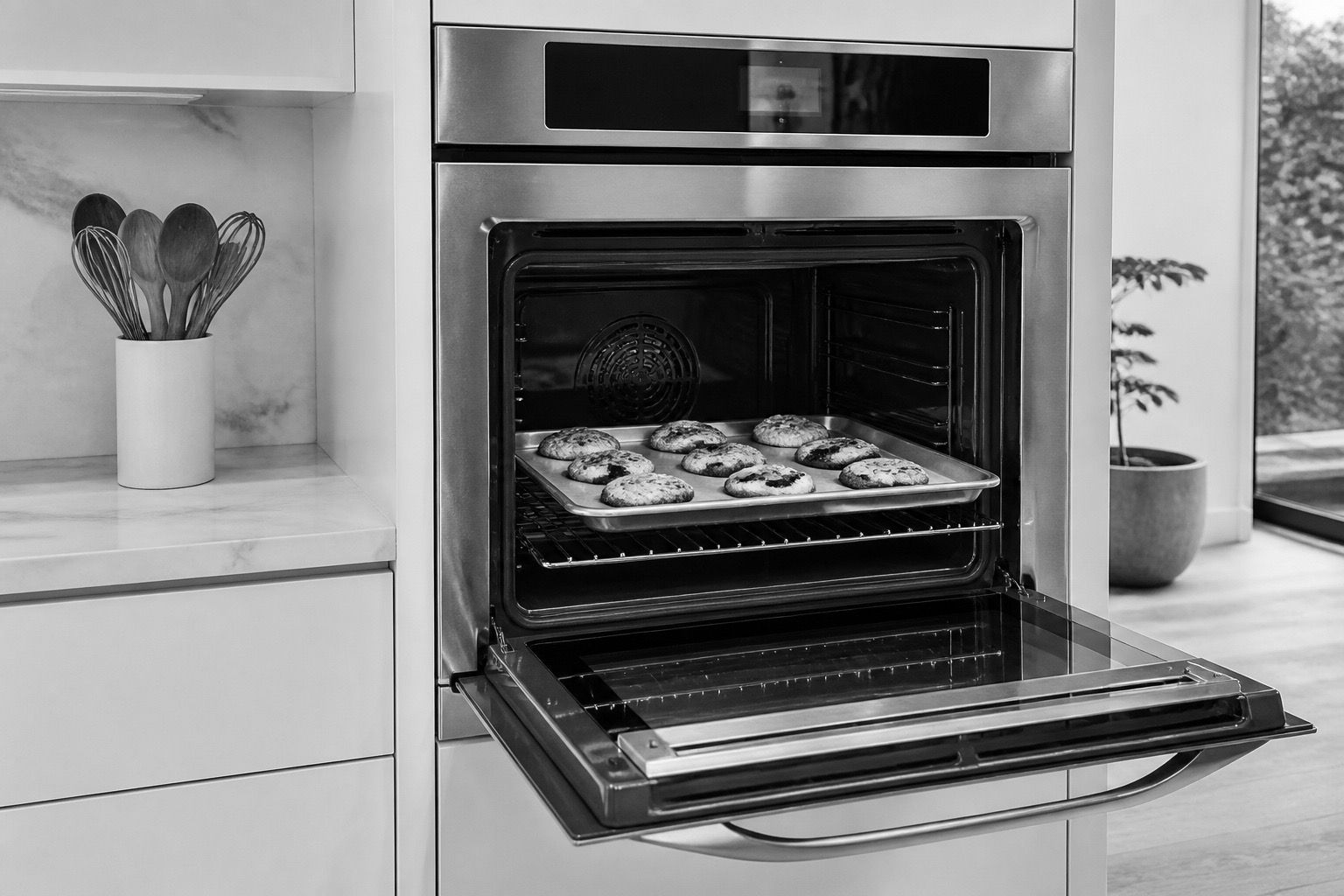
An oven that cooks unevenly on a Miele usually comes down to temperature too high, the wrong shelf level, a shiny or light pan, or something blocking airflow. Fix those first. A consistent gap that survives a full preheat and a sensible pan choice is the case for a technician to test.
Uneven cooking in an oven does not by itself identify a failed part. Begin with observations that are safe and repeatable, and keep a record of them available in case you arrange a Miele service visit at some later point.
Owner care sits on one side; testing and disassembly sit on the other. Never override a lock, a safety switch or an error message to keep the oven going, and write down a few details now to speed up the diagnosis later.
Start with the simple conditions
Preheat all the way, put the food on a center rack when the recipe permits, and skip oversized pans or packed trays that choke airflow. Leave the oven where it is and do not force panels, fittings or controls. If a small change alters the result, bake once more normally before drawing a conclusion.
If only one recipe turns out differently, technique may be to blame; if one side keeps undercooking, a temperature diagnosis becomes reasonable. Look for the pattern too: every bake, only certain loads or settings, or only after the oven has been on a while. That is more useful than restarting it over and over.
| Outcome | Probable cause | Check you can do |
|---|---|---|
| Browning uneven | Airflow crowded | Bake one tray, centered |
| Baking runs slow | Preheat unfinished | Wait for the ready signal |
| Big temperature difference | Sensor or element | Book testing |
How do pans, racks and modes affect browning?
The manual for one Miele range says light-colored shiny pans brown worse than dark matte ones in Surround mode, and that shiny materials like stainless steel and aluminum reflect heat and give uneven results. It also says not to cover the floor or rack with aluminum foil.
Temperatures above the recommendation shorten cooking time but cause uneven browning. Set cake pans with the long side across the oven width.
| Result | What it can point to | What you can safely check |
|---|---|---|
| Top browns too much | Temperature too high or wrong shelf | Lower the temperature and move the shelf |
| Pale bottom | Light shiny pan | Try a dark matte pan |
| Hot spots | Trays or grease filter blocking airflow | Remove obstructions from the cooking area |
| Delicate cake uneven | Unsuitable mode | Check the manual’s recommended mode |
Safe checks that protect the appliance
Consult the use-and-care manual for your model’s controls, filter access and upkeep intervals. Clean only the parts it lists as owner-serviceable, use the recommended products, and put every removable part back as designed.
Ahead of another bake, clear anything blocking the cavity, reduce an unusually heavy load, and check that airflow, supply connections and door clearance are not restricted. Resetting again and again can hide an intermittent fault and may leave heat or pressure where it should not be.
- Record any displayed message or error code before you clear it.
- Examine visible vents, seals and plugs by eye without disturbing electrical connections.
- Make one controlled test instead of repeated quick tries.
Fine for owners
- Move the rack
- Pick the right cooking mode
- Preheat completely
Technician only
- Taking out heating elements
- Measuring live voltage
- Forcing the door latch
When might the oven itself be at fault?
Miele US support on a top-browning complaint lists temperature too high (reduce by 25-50 F), wrong shelf level, an unsuitable mode for delicate cakes, and trays or a grease filter obstructing airflow. If those do not change anything on repeated bakes, the cause is outside what you can test at home.
Two oven states can mimic a fault: Demo mode, where menus respond but the oven does not heat, and a safety shut-off after an unusually long run that you confirm with OK. Check your manual for both.
Know when the symptom needs diagnosis
If nothing changed, the remaining possibilities lie beyond owner service. Testing internal wiring, heating circuits, pumps, motors, refrigerant lines, gas connections or control boards takes proper equipment and a technician who can make sure the repair is safe.
A technician visit is warranted quickly if performance keeps slipping, a breaker trips, something leaks close to electrical parts, a hot or burnt smell shows up, a new grinding noise starts, or the oven cannot complete a normal cycle. Leave an appliance off once it gives a safety warning.
What to tell the technician
Provide the model number, the exact symptom, when it began, the settings in use and the results of the safe checks. A photo of a code or a short description of a noise helps, though a cover should never be removed to get it.
Observation will not do a repair’s job, but it is the best place to begin. Settle the simple conditions, keep any error information, and give electrical, gas, sealed-system and internal mechanical work to a qualified Miele technician.
Common questions
Should I reduce the temperature if the top browns too fast?
Miele US support suggests reducing 25-50 F as one fix, along with checking shelf level. Try one change at a time.
Does aluminum foil in the oven cause uneven cooking?
The manual says not to cover the floor or rack with foil, since shiny materials reflect heat.
Which pan color is best?
The manual says dark matte pans brown better than light shiny ones in Surround mode.
Need help now? Visit our services page or contact us.
Official manuals and support notes are available on Miele Support.
Put the complete model number on paper before ordering any part, because revisions to boards and sensors can change which number is correct.
Switching power off and on once can clear a short-lived fault, but a code that returns repeatedly usually means a physical cause persists.
Airflow that is restricted often passes for an electrical or sensor failure, so keep vents and filters clean in the time between visits.
Spotting water, burning smells or sparks means the appliance should go off until a professional has looked it over.