

Article details
When a Miele dishwasher leaves water in the cabinet after a program, the water was not pumped away. The first checks are the filter combination, any kink or loop in the drain hose, and the message on the display. The drain pump comes later and only with the machine off and unplugged; if water remains after that, book a visit.
Water sitting in the bottom of a dishwasher does not by itself point to a failed part. Start with observations that are safe and repeatable, and keep them on hand in case you arrange a Miele service visit afterward.
Some tasks are plain owner care; others call for testing equipment or taking the machine apart. Never defeat a lock, safety switch or error message to keep the dishwasher going, and make a few notes now so whoever diagnoses it later can work faster and more accurately.
Start with the simple conditions
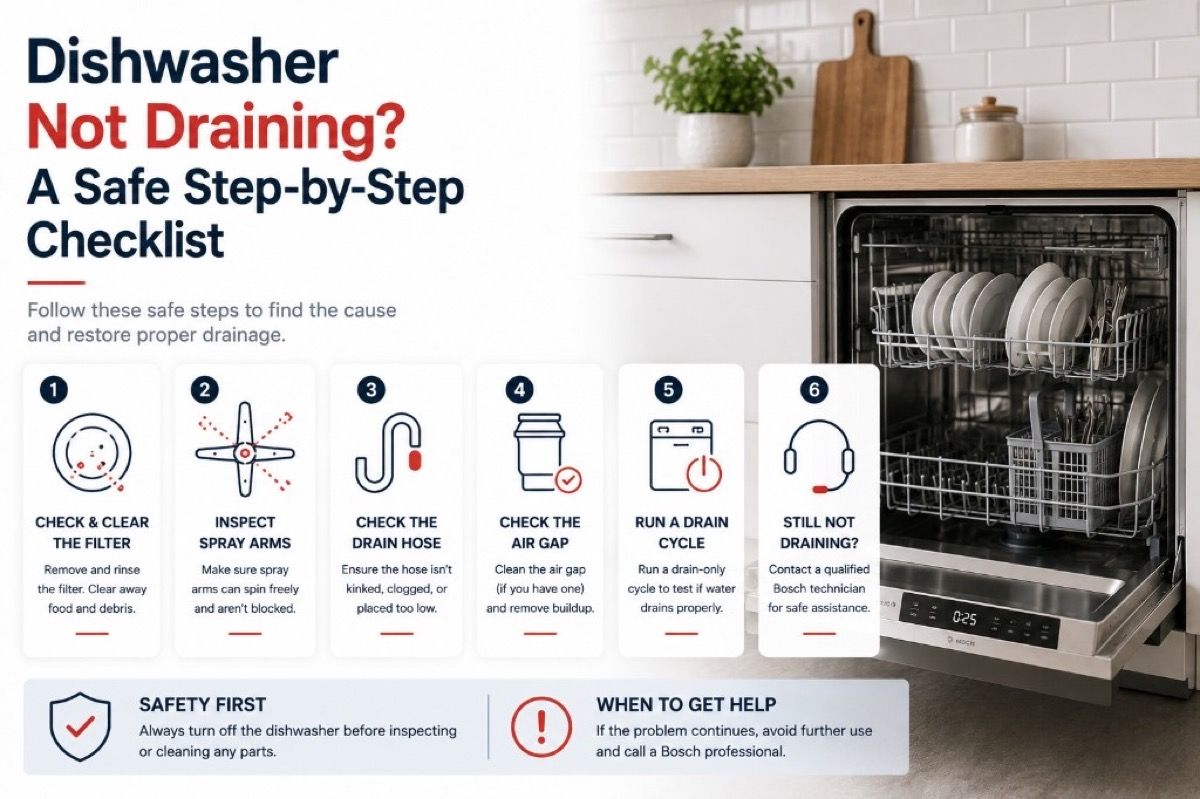
Stop the cycle if it is still running, give the tub a moment to settle, then follow the manual to take out and rinse the filter you can reach. Keep the machine where it is and do not force panels, fittings or controls. If a simple adjustment changes the result, run one normal cycle before concluding anything.
A visible kink in the hose you can reach, or a disposer connection fitted recently, can account for a drainage complaint without any pump failure. Watch for timing too: each cycle, only with certain loads or settings, or only after the machine has been running a while. That pattern says more than restarting it repeatedly.
| Symptom | Probable cause | Check you can do |
|---|---|---|
| Water left after a cycle | Debris in the filter | Rinse the filter |
| Draining slowly | Hose pinched | Look over the visible hose |
| Drain code shown | Blockage or pump trouble | Write the code down |
What does the manual list for undrained water?
In the manual for one class of Miele dishwasher, the “Water was not pumped away” message comes with three steps: clean the filter combination, clean the drain pump, and straighten out any kink or loop in the drain hose. Water left in the cabinet means the machine did not drain, and the manual adds that foreign objects can block the drain pump and are simple to take out.
The drain hose must not be shortened, and any extension must be a Miele extension hose. That matters if the machine was moved or a new sink connection was made.
| What you notice | What it can point to | What you can safely check |
|---|---|---|
| Water in the cabinet after a program | Filter combination blocked | Switch off and clean the filter combination |
| Slow drain | Kink or loop in the drain hose | Look at the visible hose route |
| Drain message on the display | Blocked filter, pump or hose | Note the wording and work through the three steps |
| Musty smell with standing water | Soil trapped in the filters | Clean the filters and run a high-temperature program |
Safe checks that protect the appliance
The use-and-care manual spells out the controls, filter access and upkeep intervals for your particular model. Clean just the parts it lists as owner-serviceable, use only the products it suggests, and put each removable piece back as the design intends.
Prior to running another program, clear any obstruction, cut back an unusually full load, and make sure airflow, the water supply or door clearance is not hemmed in. Pressing reset repeatedly can conceal an intermittent fault and may leave water, heat or pressure where it should not be.
- Copy any displayed message or error code before you clear it.
- Check the hoses, vents, seals and plugs you can see, leaving electrical connections undisturbed.
- Choose one controlled test over a run of quick retries.
Fine for owners
- Wash out the filter
- Check how the visible hose runs
- Write down the error code
Technician only
- Put a hand into the pump
- Detach wiring
- Force drain cycles over and over
Why does the drain pump step need extra care?
For the pump, the manual says to switch off and unplug, take out the filter combination, scoop out the water, press the pump cover catch inward and tip the cover out. The impeller should turn with slight resistance. Glass splinters are hard to see in the pump, so the manual says to take care.
If the impeller does not turn, or you are not comfortable working near the pump, stop there. A check result of an impeller that turns freely does not prove the pump is healthy; it only rules out a simple jam.
Do not run the machine without the lower spray arm or the filters while you test, since soil can enter the circulation system and block it. Dirty or misseated filters are also a listed reason for poor cleaning.
Know when the symptom needs diagnosis
The line for owners ends with the basic checks. If they change nothing, leave wiring inside, heating circuits, pumps, motors, refrigerant lines, gas connections and control boards to a technician with the proper instruments, who can verify a repair is safe.
Arrange service soon if things are getting worse, a breaker trips, water appears near electrical parts, there is a hot or burnt smell, a new grinding sound begins, or a normal cycle will not complete. Stop using any appliance that shows a safety warning.
What to tell the technician
Pass on the model number, the specific symptom, when it began, the settings chosen and what the safe checks revealed. A photo of a code or a short description of a noise can be useful, but do not remove a cover to get either.
Close observation cannot replace repair, though it is a sound first move. Handle the simple conditions, hold on to any helpful error details, and give electrical, gas, sealed-system and internal mechanical jobs to a qualified Miele technician.
Common questions
Why is there still water in my Miele dishwasher after the cycle?
It was not pumped away. The usual causes the manual lists are a blocked filter combination, a blocked drain pump or a kinked drain hose.
Can I shorten or replace the drain hose?
Per the manual, never shorten the drain hose, and use only a Miele extension hose to lengthen it.
Should I keep restarting the program?
Repeated restarts do not clear a blockage and make it harder to describe the fault. Clean the filter, check the hose and note the message first.
Need help now? Visit our services page or contact us.
Official manuals and support notes are available on Miele Support.
Before buying a part, write down the entire model number, because revised boards and sensors can alter the correct part number.
Resetting power once can clear a temporary fault, but a code that returns again and again usually means something physical remains.
Keep filters and vents clean between visits; limited airflow frequently resembles an electrical or sensor failure.
Water, a burning odor or sparking means you should stop running the appliance and have it inspected by a professional.