

Article details
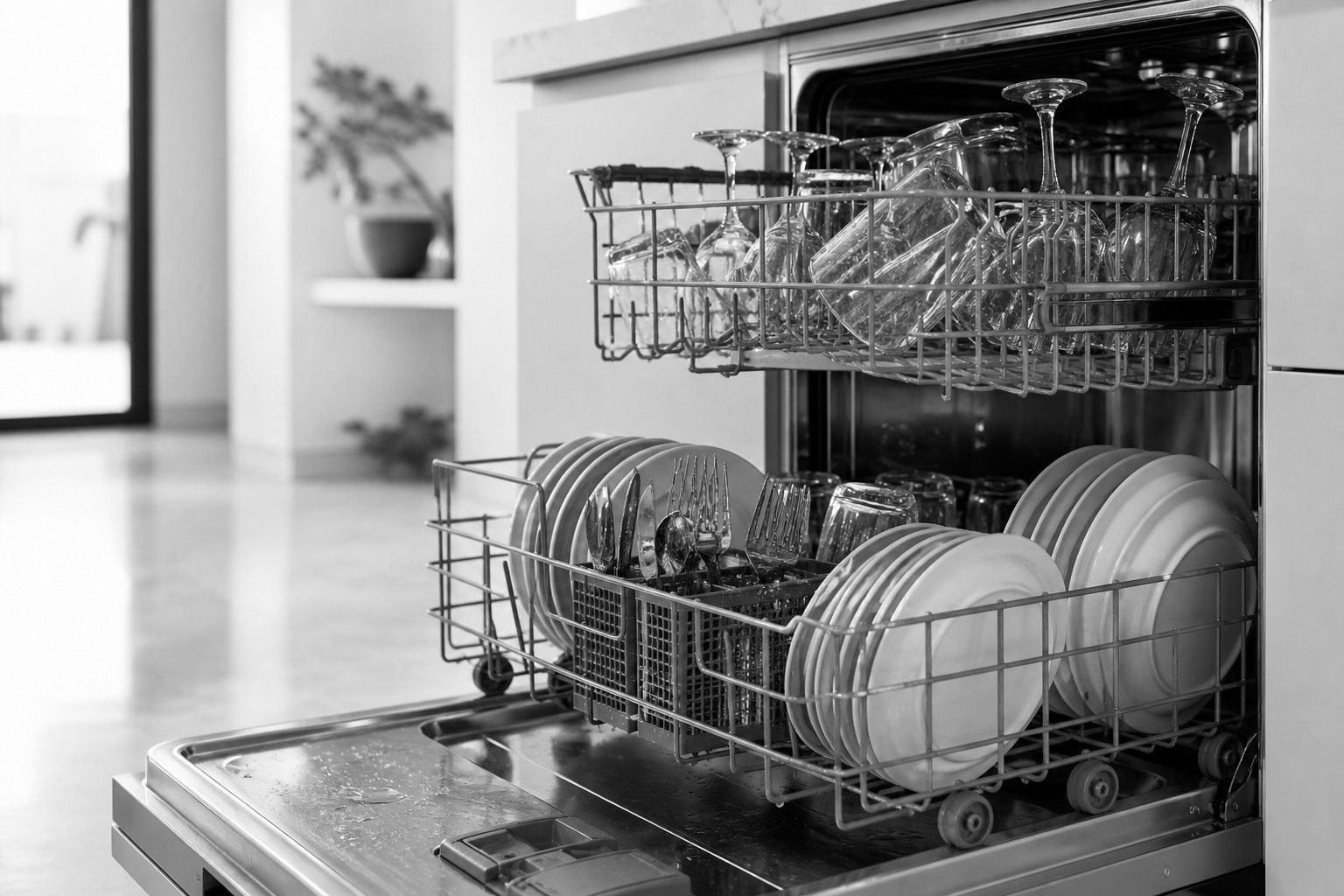
A Miele dishwasher that leaves dishes wet most often comes down to rinse aid that is empty or dosed too low, a detergent type that drying does not like, or dishes unloaded too early. A damp door interior after a program is a normal result of the drying system, not a fault. If rinse aid, detergent and loading all check out, book a visit and describe which items stay wet.
Dishes that come out wet do not point to one failed part on their own. Start from observations that are safe and repeatable, and hold on to them in case you later book a Miele service visit.
Owner care and work needing tests or disassembly are separate categories. Never defeat a lock, safety switch or error message to keep the dishwasher running, and take a few notes now; they make the later diagnosis faster and more accurate.
Start with the simple conditions
Top up the rinse-aid dispenser, make sure its dosage is above the minimum, and tilt cups or plastic containers so they cannot collect water. Keep the machine where it normally sits and do not force panels, fittings or controls. If a simple change helps, run one normal program before deciding.
Condensation drying relies on warm surfaces and moving air, so opening the door ahead of the program’s end can weaken the drying outcome. Also look for a pattern: every load, only particular loads or settings, or only after the machine has been running a while. Seeing that is worth more than restarting it repeatedly.
| Outcome | Probable cause | Check you can do |
|---|---|---|
| Wet plastic | Material holds water | Tilt the items |
| Water in mugs | Position in the rack | Turn cups face-down |
| Everything wet | Rinse aid or its setting | Top up the rinse aid |
Why does the dishwasher door open a little after the cycle?
Many Miele models let the door swing open a little by itself when a program with a drying phase ends; this assists the drying.
At the end of programs with a drying phase, the door on many Miele models opens a little by itself to help drying. The manual for one model calls this AutoOpen, says it can be deactivated in the settings menu, and says it does not apply to the Extra Quiet program. Opening the door at the end of a program also lets dishes cool much faster, and the drying fan may keep running for a few minutes after the program.
A door that opens on its own and a fan that runs on are therefore expected.
| What you notice | What it can point to | What you can safely check |
|---|---|---|
| Glasses spotty and wet | Rinse aid empty or dosage too low | Refill the reservoir and raise the dosage one stage |
| Dishes cloudy or smeared | Rinse aid dosage too high | Lower the dosage and wipe up any spill |
| Dull drying with combination tabs | Tabs can impair drying | Switch detergent or add rinse aid |
| Wet door interior and cabinet walls | Normal effect of the drying system | Wait; the moisture dissipates |
Safe checks that protect the appliance
The use-and-care manual describes the model-specific controls, filter access and upkeep intervals. Clean only parts it calls owner-serviceable, use the cleaning products it recommends, and refit each removable piece in the way it was designed to sit.
Before starting another program, clear obstructions, lighten an unusually full load, and confirm that airflow, the water supply and the door’s clearance are not restricted. Resetting repeatedly can mask an intermittent fault and may leave water, heat or pressure where it should not be.
- Write down any displayed message or error code before clearing it.
- Look at visible hoses, vents, seals and plugs while leaving electrical connections alone.
- Do one controlled test in place of several in a row.
Fine for owners
- Add rinse aid
- Load so water runs off
- Let the program finish
Technician only
- Opening heater circuits
- Changing drying controls inside
- Running damaged racks
How should rinse aid be set to avoid spots and wet dishes?
Rinse aid is needed to prevent spotting, and the set amount is dosed automatically from a reservoir. On the manual’s model the dosage runs in stages from 0 to 6 and is 3 at the factory. Raise it if spots appear and lower it if clouding or smearing appears. When the Refill rinse aid message shows, the reservoir holds enough for only 2 – 3 programs.
Fill only until rinse aid is visible in the opening, wipe up any spill to prevent over-foaming, and close the flap firmly until it clicks, since otherwise water can enter the reservoir during a program. Only rinse aid made for residential dishwashers belongs there; detergent damages the reservoir.
The Extra Dry option improves drying where it is available, at the cost of higher energy use. The manual also says the results of Tab detergents can vary greatly, and that rinse aid is not needed with tabs.
Know when the symptom needs diagnosis
When the basic checks do not move the symptom, stop at what an owner can service. Wiring inside, heating circuits, pumps, motors, refrigerant lines, gas connections and control boards need proper test equipment and a technician able to confirm a safe repair.
Schedule service promptly if performance is worsening, a breaker trips, leaks reach electrical parts, a hot or burnt smell appears, a new grinding noise starts, or the machine cannot finish a normal program. Do not carry on using an appliance with a safety warning.
What to tell the technician
Tell the technician the model number, the exact symptom, its start, the settings selected and how the safe checks went. A photo of a code or a short note about a sound can help, but do not remove a cover to get one.
Observing is not the same as repairing, but it is the smartest way to start. Resolve the simple conditions, preserve any error information, and entrust electrical, gas, sealed-system and internal mechanical tasks to a qualified Miele technician.
Common questions
Why are my plastics always wet when the glasses are dry?
Plastic items that are not heat-resistant can melt or lose shape in a dishwasher, and angle them so water cannot pool. Check the rinse aid dosage first, because the manual lists a low dosage or empty reservoir as a cause of dishes that are not dry.
Is it normal for the door to open by itself at the end?
On many Miele models, yes. AutoOpen helps drying and can be switched off in the settings menu if you prefer.
Does the order I unload matter?
The manual says to unload the lower basket first, then the upper basket, then the cutlery tray, so drops from above do not fall on dry dishes below.
Need help now? Visit our services page or contact us.
Official manuals and support notes are available on Miele Support.
Get the whole model number written down before you order a part, as board and sensor revisions can change the part number that fits.
Cycling power once may clear a temporary fault; when the identical code keeps returning, a physical cause usually remains.
Between visits, keep vents and filters clear. Restricted airflow can easily look like an electrical or sensor failure.
With water, burning smells or sparking present, switch the appliance off and arrange for a professional to inspect it.